20 October 2011
Tim Berners-Lee, inventor of the world wide web, delivered the closing keynote at RSA Conference last week, outlining some of his ideas for a more secure web.

Photo of Tim Berners-Lee speaking at RSA Conference 2011.
Photo ©Sean McManus
For the future of the web, it’s critical for applications to be able to access information from other applications, he said. He gave the example of those web-based event planning apps where each person in a group of friends enters the time and date they could meet up, and the app finds a consensus. The computer already has each person’s calendar, though, so it’s got a good hunch about when people are doing important things already. You end up with people typing in information that the software already has.
Berners-Lee spoke about software having what I would describe as “a conflict of interest”, for example an auction application which might represent his bids but also has access to everyone else’s and could easily cheat. The issue of trust is key, and Berners-Lee suggested we might use different parts of the screen or different colours to help identify the different sources of data and how trustworthy we should consider them to be. He also gave the example of software he uses to manage his tax return, and said he was “shocked and disturbed” when the software asked if it could sell him insurance. If he pays for software, he says, he wants to know it’s working on his behalf, and he was so annoyed by this that he gave up using the application and wrote his own instead. This is a problem that’s less of an issue with a website like a travel agent’s site, because Berners-Lee assumes the application is working on the travel agent’s behalf there, he said. As we move to the cloud, it strikes me that new types of advertising become technically possible but Berners-Lee insisted the cloud needs to be under the user’s control, with no backdoor for serving ads based on the data stored in it.
The key is that there needs to be a way for the user to control the resources every application gets, Berners-Lee said, including CPU, memory (local and in the cloud) and the disk and camera. He said he wants to be able to give particular apps, people and groups access to different pieces of data on all his devices, without any defaults that might result in data leaking and without having to set it up from scratch for each new app. And there needs to be a clear, colour-coded user interface, that makes it easy to see at a glance who has access to different types of data (such as family, work colleagues, everyone, and the user only). For example, he might use an exercise app which tells everyone he did 40 minutes of exercise, show friends and family the GPS trail of the path he took, and reserve details of his weight for his eyes only.
If it’s possible for apps and people to share data in a secure way, under the user’s control, there will be an explosion in apps that can talk to each other, which could lead to all kinds of new ways to share and process our data.
What do you think the future of web-based apps looks like?
Labels: internet, technology, webdesign
Permanent link for this post | Blog Home | Website Home | Email feedback
26 August 2011

When I was writing iPad for the Older and Wiser, I was surprised to see that Alaska Airlines was replacing its flight manuals with the iPad. Now, the Guardian reports that United and Continental are also going paperless thanks to the iPad, and American and Delta airlines are testing the technology.
There’s a lot of money at stake. The Guardian reports that switching from 38lbs of paper to adopt the 1.5lb iPad will save 326,000 gallons of jet fuel each year, and 16 million sheets of paper. There’s no announcement as to how many back injuries it will prevent, by avoiding the need to lug around all that paper. The investment should pay for itself in five years, with $5 million being invested in iPads and $1 million being saved each year, which is an admirably long term investment in an uncertain economy.
To make sure there’s a failsafe, the pilot and copilot will each have iPads, so that if one fails, the other should still be available. If both fail, then information can be radioed to the cockpit. Unless the radio fails, I guess.
I’m not sure how I feel about this move. Given the amount of documentation that accompanies a flight, I imagine an iPad could make it much easier to find important information quickly, and the backlight might make it easier to read in difficult circumstances. But there’s something reassuring about the fact that a book never crashes or runs out of juice. I’m a fan of the iPad, obviously, but you can’t beat paper for accessibility. That said, the Federal Aviation Administration in the US insists that extensive safety testing is carried out before the iPad is introduced in the cockpit, and I’m sure they are used to dealing with much more sensitive systems than the iPad.
Unless the iPads are locked down to prevent new apps being installed, pilots will need to resist the temptation to install games. Here’s hoping that the only angry birds the pilots see while flying the plane are through the cockpit window.
(The picture is a press photo from Alaska Airlines, showing a pilot using an iPad in the cockpit. This photo was issued in May 2011 when Alaska Airlines became the first airline to use adopt the iPad for flight documentation.)
Labels: iPad, technology
Permanent link for this post | Blog Home | Website Home | Email feedback
25 August 2011

Steve Jobs (pictured right in 2010) has stepped down as CEO of Apple, but will continue to be chairman. While Apple argues it will make little difference to the company’s operations, the stock market disagrees. The BBC reports that Apple shares fell 5% in after-market trading on the Nasdaq, and fell 4.1% in the secondary listing on Frankfurt’s stock exchange. The BBC also implies that a 4.1% rise in the share price of HTC and 3.2% rise in Samsung’s share price are also related to Jobs stepping down.
Apple has a talented team, including British designer Jonathan Ive who led the design of the iPod and the iPad, so the company remains in a strong position to innovate and grow. But many people, including many shareholders, perhaps, believe that a lot of Apple’s vision has come from Jobs.
'Revolutionary' is a word that's overused in technology PR and journalism, but Apple really has transformed entire industries under Jobs' leadership. The company has completely transformed the music industry, to the extent that Apple is arguably the most powerful company in the business, making huge amounts of money from the hardware and being one of the leading retailers for downloadable music.
Apple ignored the conventional wisdom on how the mobile phone market worked, and changed the game there too. Before the iPhone, handsets were free and operators got most of the money. Now, many people are willing to pay for an iPhone, and a huge chunk of the money in the industry goes to Apple, for both the hardware and the apps on the phone.
Apple has also dramatically reinvented the software industry. The app store model has changed the way that people discover and buy software, and has also made them much more likely to do so. People who wouldn’t enter a software or games shop are happy to buy apps, and a whole industry of amateur app developers has grown up to create those apps, some of whom have become fantastically wealthy.
Apple has also led the way with tablets, inspiring lots of other companies to try to emulate the success of the iPad. Now it’s a huge success, it’s easy to forget that a lot of people didn’t understand the point of the iPad when it first came out. It was a big iPod, or a computer without a keyboard: it seemed to be neither one thing nor the other. I didn’t get it until I tried one, but when you try one, you see how easy it makes it to do the things you usually do with a computer, and how enchanting the whole experience is. I’m a huge fan of the device, so much so that I’ve written a book about the iPad.
Apple hasn’t always been first to market with its ideas. There were MP3 stores and software downloads before Apple, for example, and there were portable music players before the iPod (including the Rio, which I reviewed for Making Music in 1999, and which could store an amazing 30 minutes of music by default). But being first to market isn’t always the most important thing. Apple shows that you can take existing ideas and improve them, design elegant products, and customers will follow.
Jobs will stay on as chairman of the company, so it can continue to benefit from his vision and ideas. Freed up from the day to day responsibility for running the company, Jobs will be free to focus his energies purely on generating ideas and helping to direct strategy. For a company led by sometimes daring ideas, this could make Apple even stronger.
(Photo of Steve Jobs courtesy of Matt Yohe, via Wikimedia Commons).
Labels: iPad, iPad 2, iPod, music, software, technology
Permanent link for this post | Blog Home | Website Home | Email feedback
20 April 2011
Amazon has today announced that it will enable people to borrow ebooks from 11,000 US libraries.
This raises a lot of interesting questions because one thing that makes the traditional lending library work economically is that both shelf space and printed books are a limited resource. If libraries could give away all books for free to as many readers as they liked simultaneously, there would be no market for book publishers to sell to. As a result, there would eventually be no professionally produced books. With the greatest respect to self-publishers and Creative Commons enthusiasts, most of the best books are still a result of the traditional publishing model, where talented writers can afford to dedicate themselves to their craft.
In the Kindle store, these limits are not inherent in the system: the store can accommodate pretty much as many books as are published to it, and the cost of reproducing the book for multiple readers is zero. So, if you could download any book you wanted at any time to your Kindle, why would you pay for it?
I'm sure Amazon is sensitive to this issue, although technology-led businesses often rush to innovate without really thinking through how they will affect older intellectual property-led industries. (Which they should, when they're trading on their IP). Amazon is partnering with Overdrive, which already offers ebook library services to universities and companies.
I guess the model is likely to be that libraries have to buy a particular book in the Kindle store, and that the system manages loans to ensure each library is only lending the number of copies they've paid for. It might also be that the library doesn't pay for owning the book, but pays for each loan instead, although a model like this would need the consent of rights holders. It would take the guesswork out of stocking the library, though, and enable rights holders to receive ongoing income that reflects the popularity of their work.
Amazon's core business is book sales, too, so they'll want to ensure there's an incentive for someone to buy the Kindle edition. Any annotations you make in the library copy will be carried over to your copy if you later buy the book, which is a nice touch. The annotations are tied to the reader not the book, so every borrower gets a crisp new copy.
There are a couple of other concerns with this model. Firstly, you need a Kindle to participate. If someone can't afford a Kindle, they definitely can't afford to buy books, and it is these people who most need the support of a library. It would be a grave mistake if ebooks were allowed to cut into library book budgets too deeply, at least until the cost of ebook readers drops to negligible. If libraries need to buy Kindle versions of the books they stock, book budgets could be depleted quickly to cater for a relative minority. (If libraries aren't buying Kindle books, negotiations with publishers will be necessary to acquire the right to lend books that haven't been paid for.) We've seen lots of library closures in the UK and it's clear that you can't replace a library with an ebook facility, and that libraries need to be careful with their spending if they are to survive.
Amazon has won its leadership position in the ebook market through having the grit and spark to bring the device to market and inspire readers with it. But it's also a concern that it's too early to entrench any one ebook reader provider with a monopoly position in the libraries sector.
So far, the new project has only been announced, which means it doesn't (in all likelihood) even exist yet. It will be made available later this year, at which point the answers to these questions should become clearer. If you've borrowed ebooks from a library before or know more about how the model works, feel free to leave your comments below. Do you think this is a positive step for libraries, or is it a divisive move that could hurt those who most need libraries, and undermine the publishing industry?Labels: Amazon, Kindle, libraries, publishing, technology
Permanent link for this post | Blog Home | Website Home | Email feedback
11 March 2010
I always recommend that writers own the relationship with their readers as far as possible. That means owning your own domain name. All those blogs out there hosted on blogspot.com (and wordpress.com) don't actually belong to their owners: they belong to Google and Wordpress, respectively. While they don't lay claim to the copyright in the content, they have absolute control over whether it is displayed or not, and to whom. If your blog is on either of those services, it could be switched off for technical or commercial reasons at any time, and you'd have no control over that.
A lot of people tell me to calm down and that I'm scaremongering when I talk about this kind of thing, but there is a precedent out there. MP3.com was a precursor to MySpace, a site where musicians could post their music for fans to discover and download. In 2003, it was sold to Cnet and all the site content was deleted. It's easy to upload the music somewhere else again, but what was lost was the relationship between band and fan. A band might have spent six years building up links to its MP3.com page, only to find that they were all now broken. Search engine traffic went into a black hole. Bookmarks in fans' browsers didn't work any more, either. Bands who might have had a big following at MP3.com had to start from scratch.
There is a simple way to avoid this problem: buying your own domain name. Your domain name is your location on the internet. In my case, it's www.sean.co.uk. You can buy a domain name for about a tenner (I use Easily for several of my domains), and you can still use services like Blogger and Wordpress. Your website address can act like a postal mail forwarding service, redirecting visitors to your blog at blogspot.com or wordpress.com when people arrive at your domain. But if blogspot goes down, you can just redirect your domain elsewhere. You keep all the incoming traffic.
I've been using Blogger for several years, because you don't have to install any software but it will still post to your chosen hosting provider (using FTP). That means it's easy to integrate my blog with the rest of my website, and I can keep all the files in one place.
Recently, Blogger has announced that it will be discontinuing that service, and instead you'll need to host your blog with Blogger. That sounded like it was going to be a lot of work or result in the loss of control, but that wasn't the case. Blogger's FTP migration tool made it easy to manage the whole process, and my blog is now hosted at http://news.sean.co.uk. If I want to, I can later redirect that somewhere else, and retain control of my content and traffic. The rest of my site remains hosted where it always was. If you don't have a site to integrate your blog with, you can buy a domain through Google and have it host it, as the simplest solution. Even though Google's hosting it, it's your domain and you can move it somewhere else later, taking all your traffic with you.
I can understand why Blogger's made this move. Google says that a tiny proportion of people were using the FTP posting feature, and that it was becoming difficult to maintain. Let's not forget it is a free service. The posting had become time consuming for me too, probably because the link between Google and my host wasn't fast enough. Now that I've migrated, my blog is lightning fast in updating. So fast, in fact, that I didn't think it was doing anything at all at first.
If you are using the FTP posting feature in Blogger, you have until 1 May to complete the process. It will take a day or so though (not work time, waiting time for servers to update), so I recommend you start early. That will also give you time to fix any issues arising before you lose control of the ability to post to your blog. Google's dedicated FTP migration blog is worth a read, but don't be daunted. You can probably dive into the migration tool without too much trouble.
If you use Google Reader or a similar service to follow this blog, please update your RSS feed. My new RSS is behind this link. The new web address for this blog is http://news.sean.co.uk. There are links scattered throughout the site to the old blog and I'll update those over time, although there is an automatic redirect on every old post to bring you to the corresponding new post location. Thanks for your patience if you stumble across old blog links. The navbar at the top of the screen should always bring you to the new blog.Labels: blogging, software, technology, writing
Permanent link for this post | Blog Home | Website Home | Email feedback
17 December 2009
Windows Live Writer is free desktop software for writing blogs, created by Microsoft. It's a much quicker way to write, preview and publish blogs than using Blogger's web interface, and it's compatible with a wide range of blog publishing systems (including Wordpress). I was impressed at how it imported my blog template to provide a fast and realistic preview.
But, and this is a big but, it cannot handle the pound sign. If you type it in from the keyboard, it gets converted into typographic junk on the published blog. If you add the correct HTML entity in the HTML mode, it is converted back into the pound character (which does not publish correctly) if you preview or use the visual edit mode. Basically, to fix pound signs, you'll probably have to log in to Blogger (or Wordpress perhaps, if this fault applies there too) to fix it.
It might seem like a minor flaw, but if I'm going to use a tool for blogging, I'd rather use one tool and know it works. I don't want to find I can't write about the currency of my country and many others without engaging in ridiculous workarounds.
A good piece of software has been spoiled by poor testing and internationalisation.Labels: software, technology, writing
Permanent link for this post | Blog Home | Website Home | Email feedback
24 October 2009
I was interested to see a story in The Telegraph (link no longer available) (and other newspapers) last week claiming that using Google can help to delay dementia. It's based on research from UCLA (link no longer available), presented at the 2009 meeting of the Society for Neuroscience, and announced in a press release. I thought this might be a nice piece of trivia to include in my next book Social Networking for the Older and Wiser.
When I studied the press release, though, I was surprised to see that there was no mention of dementia. I asked UCLA whether the dementia angle is something that has come through UCLA interviews, is in the full research report, or is something that the media have added to spin the story. UCLA kindly replied with a copy of the poster (which is what was presented at the event), the abstract and press release. The researchers confirmed that the information presented at the meeting followed the content of those, which make no mention of dementia.
The research is fascinating, and did find first-time internet users experienced more brain activity in the areas associated with working memory and decision making. "The results suggest that searching online may be a simple form of brain exercise that might be employed to enhance cognition in older adults," said Teena D. Moody, the study's first author and a senior research associate at the Semel Institute at UCLA. But there's no speculation regarding dementia in the released materials.
There's a gap here between what the study appeared to discover, and what the headlines screamed (at about 20 publications, including the Daily Mail). I'm no scientist, but if the dementia angle were true, I would have expected to see it in the press release. Apart from how much easier it would make it to promote the research, tapping into a major health concern helps research bodies to attract funding.
If the source isn't UCLA, how did so many outlets get the same angle? It's possible they pulled it from the same syndicated content which is how several newspapers came to quote a fake David Milliband Twitter feed when Michael Jackson died. It's also possible that they're watching each others' websites all day, and one over-eager sub bigged up the story, and all the others followed suit. Maybe they have an alternative source (including other scientific publications), although it's odd they haven't mentioned it. I can't trace a credible source using the dementia angle.
What bothers me most, though, is this: I consume hundreds of news stories a week. When I take the time to actually dig into one of them (I've probably spent about an hour on this), it proves extremely difficult to back it up. None of us has time to check a tiny fraction of the stories out there.Labels: journalism, social networking, technology
Permanent link for this post | Blog Home | Website Home | Email feedback
08 July 2009
The news is out that Google is going after Microsoft by launching a rival to Windows. Google's Chrome OS has been engineered to work seamlessly with the web, and will likely integrate with Google's online email and document applications. Google is rather bravely claiming that there will be no viruses or malware. That's a dangerous strategy, because the moment there's a proof of concept virus, their credibility is shot.
The OS might turn out to be a great product. But it's hard to imagine it quickly unseating Microsoft. The switching costs are likely to be too high because people will only be able to switch to Chrome by buying new hardware. The Google brand is powerful, but can it persuade people to buy something that isn't Windows if that's all they've ever known?
There's also the problem of shifting towards online applications. If your data is all online, what happens if the service provider goes under or has an outage? I've had occasion to contact tech support for two social networks while I've been researching my book and the support was uncooperative, to say the least. They're free services and you get what you pay for.
There are a lot of commentators talking about how this is a serious challenge to Microsoft, but I'm not sure that the hype is justified. Why should Google have more success in selling operating systems than Microsoft has had in giving away web searches? How many people have dumped Google to use Bing as their main search engine?Labels: business, customer service, software, technology
Permanent link for this post | Blog Home | Website Home | Email feedback
11 February 2009
I've released an ebook edition of my novel 'University of Death'. It costs £5, half the price of the print edition, and is available now at Lulu. There are no shipping costs (obviously), and it is available for download immediately after payment. You can pay using paypal if you don't want to use a credit card.
This move is partly in response to an email from Sven Augustin who says he likes to read ebooks on his hacked PSP on long train journeys because it means there's less stuff to carry around. He uses the Bookr PDF reader.

University of Death on a PSP. Photo by Sven Augustin
Clearly, the way that people choose to consume content is changing. Nintendo recently released 100 Classic Book Collection for the Nintendo DS. It includes a library of many books you know you probably ought to read, but it's a shame there's no option to read PDFs of your own choice. Amazon's Kindle ebook reader
  (only available in the US) has made it to a second edition and does offer the ability to read your own PDFs, as well as providing downloadable content. Amazon warns
 that the PDF conversion is experimental, but it nevertheless creates greater opportunities for authors to distribute their content to Kindle readers. I blogged about some of the problems of distributing Kindle content via Amazon previously.
By providing 'University of Death' as an ebook, I hope I'll be able to give people more options for consuming the content as they wish. It also makes it possible for people to access the content more quickly, and to save money on ordering (no postage or print costs). People who wish to can print their own copies to read on paper.
Pricing ebooks is tricky, but at less than the cost of some music magazines, I think £5 represents fair value for the entertainment provided. People tend to think that there are no costs in ebook publishing, but actually the cost of content creation and promotion is the same as it is for printed books. Feel free to leave any comments on the pricing of ebook below.
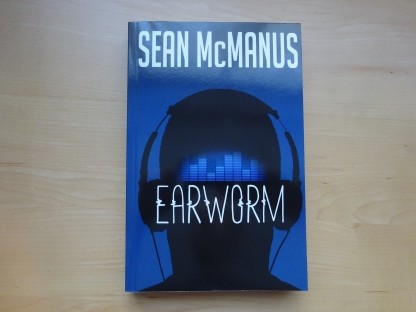
UPDATE: University of Death has been updated and republished under the title Earworm.
Labels: books, marketing, technology, university of death
Permanent link for this post | Blog Home | Website Home | Email feedback
16 October 2008
I have mixed feelings about the new DS, which Nintendo has announced for release next year in Europe. On the one hand, it's great that it includes the Opera Browser and the extra memory that requires as standard. The browser is a great tool, but probably was overpriced at £30 - it's a feature people expect to see included nowadays.
The support for SD cards might make it easier for homebrew to run on the device, which would be nice, particularly because it could help to introduce standards that make it easier to get homebrew running. Before we crack open the champagne, though, we should remember that Nintendo's taken a fairly hard line against homebrew in the past. Increasingly there are warnings on games threatening that running unauthorised devices might damage the games, and the new DS introduces region encoding, which hints that other software access controls might also be on the way.
It's also a shame to see the GBA slot go. I've bought a handful of GBA games to play on the DS, particularly retro game cartridges, and it's a real advantage to have access to a different handheld generation's software. Some of the most interesting DS software has used the GBA slot too, such as Guitar Hero (for the fret peripheral), Arkanoid (for the paddle controller available in the US), and My Weight Loss Coach (which has a pedometer that plugs into the GBA slot). The Opera browser also had a memory expansion pack, and Metroid Prime Hunters had a rumble pack (also compatible with Space Invaders Extreme, so I'm told, although since Amazon is taking about three months to deliver my copy, I might never know). That line of innovation will now slam to a halt.
The downloadable content might be good, if it's priced right. There must be a large market for people prepared to pay about a fiver for a retro game, rather than having to pay £15+ for just about anything, and typically around £25 for something good.
There might be some fun new software to emerge from the inclusion of a camera, but generally speaking the DSi feels like a bit of wasted opportunity. The original DS had an exceptional design. I don't think incorporating a couple of weak cameras and enabling music to be played from an SD card is really going to push things that far forward. In order for any improved processing power to make a difference to the software that's designed for the DS family, the DSi will need to first assume market dominance. There doesn't really seem to be sufficient reason to upgrade for most users.Labels: games, nintendo, software, technology
Permanent link for this post | Blog Home | Website Home | Email feedback
27 September 2008
I've downloaded iTunes 8, mainly for the grid viewing feature. This enables you to view your music collection by thumbnails. You wouldn't think it would make much difference, but it is a lot quicker to scroll through than cover flow view is, and it makes it possible to see more than 10 albums at a time. It makes the artwork into a much stronger navigation aid, and makes the artwork easier to appreciate too. It's already prompted me to play a few EPs that I don't very often listen to. Here's what it looks like:
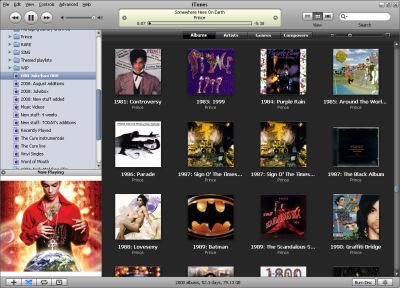
iTunes 8 showing the grid album view feature
However, there's a big drawback with iTunes 8. It turns all your music into an advert for the iTunes store. When you are viewing track listings, it adds an arrow next to each artist, album and track name which searches the iTunes store when clicked. In the typical 'list view' screen, you could have about 100 tiny advert arrows. These have always been "a feature" in iTunes, but now they've removed the tickbox that lets you switch them off.
Okay, so the software upgrade was free. But I've bought two new iPods over the years and the software is required to make them work. I've paid enough money to Apple to expect that the software would come 'free' and not become 'ad supported' in future.
From a usability point of view, it's terrible. With 100+ adverts on screen, it's easy to click one by mistake, which results in iTunes connecting (slowly) to the iTunes store and taking you away from whatever you're doing.
Interesting to note that there's no mention of this forced advertising on Apple's What's new page (no longer online), and that it isn't even shown in the screenshot they have there.
Blog The Glitch (no longer online) has a technical hack for this problem. For some reason, there were two versions of the preference file on my machine, but it worked okay when I edited them both. It did leave the arrows on the current track playing, but you can get rid of those (and indeed all the arrows) by disabling the iTunes store as a whole in the parental options. So that's what I've done, too.
The end result? I'll probably buy a lot less music from Apple. There might be times when I enable the store again to shop there, but most of the music I've bought there has been from browsing through the store and coming across something unexpected. That'll stop. I'll also be much more suspicious of Apple software in general.Labels: business, customer service, music, technology
Permanent link for this post | Blog Home | Website Home | Email feedback
15 July 2008
When I got my Amstrad in 1984, it came with one game: Roland on the Ropes. When I finally got an Amstrad emulator running on the Nintendo DS, it was one of the first games I tried. The game seems remarkably easy now, compared to how I struggled with it as a kid. But like many games from the Amstrad era, it plays as well on the handheld as it did on the chunky CPC. There are lots of well-loved games from the 80s that never had an arcade following large enough to justify a commercial remake today, and wrestling with an emulator is probably the only way you'll ever get to play them on the move.

Nintendo doesn't approve of homebrew, as a rule. One reason is that they want a slice of all the game sales revenue, and want to keep some control over quality. Another reason is that if people learn too much about how to copy files to the DS, they might learn a thing or two about piracy along the way. So getting the emulator running wasn't easy.
The first ingredient was Datel's Games'N'Music. This is an unofficial homebrew cartridge, and probably the easiest to get hold of. You can buy Games'N'Music on Amazon [broken link removed] and can probably order it in most game shops. It includes software for converting video and MP3s to the DS, and a small selection of homebrew games. If the words 'Cassette 50' mean anything to you, you'll have a rough idea of the kind of standard of game we're talking about. With no disrespect to the authors, who have climbed technical mountains to create some good-looking titles, the games don't really have the kind of complexity you might expect today.
One reason for that is that until recently, software running on Games'N'Music was unable to use the file system. With all homebrew carts, you need to patch the software in so that it knows how to use the file system on the cartridge you're using. A DLDI driver (as it's known) for Games'N'Music [broken link removed] wasn't available for the Nintendo DS until last summer. Now that it is available, much more sophisticated homebrew can be run from the cart. Much of the stuff I've tried still doesn't work, but the good news is that an Amstrad emulator does.
The emulator I've used is called CrocoDS [broken link removed]. To get it working, you patch it using the DLDI tool, and then copy the emulator software and Amstrad games to a MicroSD card that comes with the Games'N'Music cartridge. This is a simple drag and drop operation using the USB MicroSD reader that comes with Games'N'Music. The MicroSD card then locks into the main Games'N'Music card, which is like a standard NDS cartridge (although mine broke and I've had to tape it to keep it in). To get it working, I had to copy both the emulator software and the games to the root level of the Games'N'Music cartridge.
Then, you're ready to play. The Games'N'Music interface is extremely unresponsive, but if you keep poking the CrocoDS icon, it'll eventually start. And from then on, everything runs smoothly. You can insert .dsk emulator images or .sna memory grabs.
Because of the size of the screen, mode 0 works best (chunky and colourful, as seen on Chuckie Egg and Get Dexter). Mode 1 (Batman, Knight Lore etc) works well, although you might lose some definition. Mode 2 (mostly used for word processing) is virtually illegible. There is an option to view the CPC screen without scaling, but you can't scroll the area viewed, so you lose the right hand side and bottom of the screen.
The sound is faithfully reproduced, although in some games it runs at half speed for some reason. It seems to be the older games that are affected, so I wonder whether it's the games that were developed for the CPC464 that sound odd since the volume parameters changed for the later machines. The strange sound doesn't affect gameplay, in any case.
The touchscreen has a virtual keyboard, including sticky shift and control keys (so you don't have to hold them down while pressing something else). This works fine, including for adventure games. For action games, the most useful feature is the joystick and cursor key emulation on the direction pad. The A button acts as a fire button when the joystick is being emulated. The D-pad doesn't work quite the same as a joystick - the diagonal controls don't seem as smooth, but in most games that won't matter too much.
Because the D-pad can work like the CPC's cursor keys, you should be able to play pretty much any game with a redefine keys option by redefining the keys to the cursor keys. Sadly, there are some games, including one of my favourites Advanced Pinball Simulator, which aren't playable by joystick and don't have a redefine keys option.
This emulator is a fantastic addition to anyone's library. You can play classics such as Jet Set Willy, Chuckie Egg, Manic Miner, Highway Encounter, Android II, Spindizzy, Dizzy, and many more. If I didn't already have a DS, this emulator would be a good enough reason to buy one. It's a bit fiddly getting it working, but it's well worth the effort.
(Read my book about Amstrad CPC programming, download my games and find out how to run Amstrad games on your PC in my Amstrad CPC pages.)
Labels: amstrad, games, nintendo, technology
Permanent link for this post | Blog Home | Website Home | Email feedback
05 July 2008
| What I meant to blog about | What I would have said |
|---|
Sticking Space Invaders to my wall | They look awesome, but it's very fiddly unfurling them if they stick to themselves. Get some but be careful. |
| Seeing David Gilmour and Ron Geesin perform Atom Heart Mother | The extended sections were great and the choir and brass sounded fantastic. It was a thrill to be one of just 900 to witness David Gilmour perform this for the first and probably only time during my own lifetime. |
| Seeing Roger Waters perform Dark Side of the Moon at the O2 | Great show, but odd since the star only plays bass on most of it. The solo stuff worked better in many cases. After trying to get a ticket for months and only being offered crap seats, I picked up a first class seat two days before the gig, through Ticketmaster. 'Sold out' gigs are never really sold out. |
| Ripping vinyl | Some great stuff has never been issued on CD, including a lot of Prince 12"s. Being able to move music between media like this and enjoy the sounds I paid for some years ago is a good argument against DRM. Use Audacity. |
| Ripping tapes | Having a tape deck fitted in to your PC is the next big thing. For former walkman fans like me, it's an easy way to digitise all those albums I bought on tape and haven't re-bought on CD yet, and all those home recordings I made. I won my tape deck in a joke competition. |
| Gardening | We've got an allotment now. It started off with knee-high grass all over it, but we're slowly reclaiming it. This year we're growing courgettes, sweetcorn, cabbages, and rhubarb there, and in the garden we have squash, tomatoes and herbs. Cats are evil. |
| The novel World War Z by Max Brooks | This account of the Zombie war is written as a series of interviews with survivors. While the lack of a central hero or recurring character means it jumps around a lot, it is a great way to convey the scale of a planet under siege. An engrossing story, and an interesting format for fiction. |
Labels: amstrad, book review, music, technology
Permanent link for this post | Blog Home | Website Home | Email feedback
13 June 2008
I was excited when I heard about Korg developing a synthesiser program for the Nintendo DS, but yesterday I got a chance to see and hear it in action at the London International Music Show. I can confirm it's very cool. It wasn't officially on display on the Korg stand, but a gentleman called Tatsuki was kind enough to demonstrate his own pre-production copy of it, which looked like it had been burned onto a generic homebrew card.
There have been other instruments created for the DS before, but this is arguably the first that has been designed to work for solo performance (unlike Jam Sessions). You can create loops (including basic drum loops), and sequence different patterns to build up more complex pieces of music. Most importantly, you can save your creations to the card. Using wi-fi, you can apparently play with up to eight others and share sounds, although my understanding was that they would need to have their own cards too.
The sound was extremely high quality. It was being amplified through decent speakers at the show, but it sounded crystal clear and much like I'd expect an original MS-10 from 1978 to sound. Not that I have a great idea of what that's supposed to sound like, but I mean that it sounded like an instrument and not like a toy.
The synth appears to use the interface well. When you patch the effects, for example, you touch one socket and drag a cable to another socket to patch them together. The touchpad can be used as a Kaoss pad emulator, which bends the sounds playing according to how you stroke the touchpad, and adds a bit more of a human touch.
Here's my photo from the show:
It's due for launch towards the end of July, but won't be getting a UK launch unfortunately. So I guess I'll have to import it.
If you want to know what it sounds like, check out the sample song on the official website (link no longer online). There were bits in there that sounded like parts of Oxygene.
Speaking of which, the show took place at Excel in Docklands, built on the site where Jean-Michel Jarre held his Docklands concert in 1988. I hadn't been back there in twenty years, and it was strangely moving to see the Millennium Mills building still standing proud on the other side of the docks.
Labels: music, nintendo, software, technology
Permanent link for this post | Blog Home | Website Home | Email feedback
15 April 2008
I blogged about Amazon's Kindle, a new ebook reader, when it launched. But I didn't look at the opportunity for self-publishers then.
I've published a few ebooks in the past. My ebook 'Journalism Careers - Your questions answered' is sold as a PDF file designed for comfortable on-screen reading. I previously published a guide to putting sound in webpages and a Javascript tutorial through Fatbrain, which was an online ebook store. That folded years ago, and it looks like Barnes & Noble has bought the domain name.
So what's the opportunity at Kindle? Not much for me, it seems. You need to have a US postal address and US bank account details before they will let you publish any content. You can't even publish content for free and use Kindle as a promotional outlet (ebooks must be priced between $0.99 and $200, and you still need to be in the US). Given how slow Amazon's been in internationalising other features like Amazon Honor System, none of that is likely to change any time soon.
My friend John went through the motions of setting up a publication anyway, and has blogged about that experience.
There are a couple of terms that might worry some self-publishers. Firstly:3. Digital Books; Marketing and Promotion. You agree that we may market and promote your Digital Books by making chapters or portions of your Titles available to prospective customers without charge, and permitting prospective customers to see excerpts of the Digital Book in response to search queries. Amazon will not owe you any fees for the marketing and promotional efforts described above. The Program may include features that allow users to print one or more pages of your Titles.
The short version of that is: Amazon can distribute content from the book and allow users to print it, without charging for it and without paying you for it.
The 'permission to print' seems to go beyond the deal Amazon's already struck for 'Search inside this book' for promoting printed books on its website. It's essential for authors to give away some preview content to demonstrate the value of their books. Indeed, similar terms are usually a part of a conventional publishing contract. But Amazon's a shop, not a publisher. Authors and publishers should decide what material is promotional, and what material is only available for sale. Amazon wants the right to give away whatever content it wants, albeit with the implied motive that it will try to pick content that will help the book sell.
For reference works, the value could be significantly eroded if Amazon allows excerpts to be printed without any payment. We can only hope that Amazon is working on a way of administering micropayments so that people can buy book excerpts and authors can be rewarded appropriately.
Also, Amazon will keep 65% of the retail price. By comparison, Lulu charges a fee of 25% of what you get (which is then added to the sale price, so it's actually less than 25% of the ebook price). If you're a self-publisher, 35% is probably not too bad a return given that there's no work to do with moving printed books and there's no cost to incur in creating them, but it's far from competitive. It also seems to overstate the costs incurred in operating the infrastructure and underestimate the costs involved in creating content. 10. Technology. You acknowledge that we will be entitled to utilize DRM technology in connection with the distribution of Digital Books but are not obligated to do so. Accordingly, there may be no technology or other limitation imposed by us on copying or transfer of any Digital Book we distribute.
Personally, I don't approve of digital rights management technology. But when publishers are selling ebooks, they'll want to know what rights they're licensing and what controls will be used to enforce them and this term seems somewhat vague. There 'might or might not be DRM' isn't really a good basis for making a decision about whether you want to sell through Amazon, particularly if piracy or consumer rights is something you feel strongly about.
The use of the words 'irrevocable licence' set off alarm bells, but it seems this is about protecting consumers and ensuring that they will be able to download content they've bought easily in future. The irrevocable licence does not extend to making the ebook available for sale (so you can withdraw it later).
If anyone's actually self-publishing through Amazon Kindle, I'd be interested in hearing about your results in the comments.Labels: journalism, marketing, publishing, technology, writing
Permanent link for this post | Blog Home | Website Home | Email feedback
27 November 2007
Amazon's launch of an ebook reader is a smart strategic move: beat the competition by becoming the competition. The company sells most things nowadays, but built its fortune on book retailing and has since used its technology expertise to branch into search engines (link no longer available), distributed processing and micropayments (link no longer available). The company has already built relationships with publishers and has an archive of scanned material, which presumably is ready to publish digitally the moment the copyright holder gives the nod. If anyone can make a go of the ebook, then Amazon can. Kindle reportedly sold out at launch, which shows there are enough gadget freaks to sustain this kind of thing.
People compare Kindle to the iPod. We never knew we'd want to carry all our music everywhere until we could, goes the logic. I have dozens of half-read books around me right now, but I'm not convinced I need to carry them everywhere. The reason they're half-read is that I can't usually be bothered to read them. I read my better books instead. There's a big difference between a song, which you consume in about three minutes, and a book, which you consume in about three weeks. What made the iPod popular was that it was backwards compatible with CDs (and arguably with pirated material). Filling an iPod would cost an absolute fortune if you had to buy all the content again, but that's what you'll have to do with Kindle.
Kindle could emulate the iPod by creating a market for digital content, though. Nobody was fussed about buying digital music (although the options were there) until the iPod made the ownership experience so smooth. Kindle should make it much easier to buy digital content - easier than buying printed content, even. It will also establish a going rate for an ebook. At the moment, non-fiction ebooks are sold on the value of the information, independent of the number of pages. That could all change once Kindle's knocking out virtual paperbacks for a similar price to their paper equivalents. For some authors, Kindle is a threat.
Apparently, Kindle will enable you to subscribe to magazines and newspapers. It's hard to square that with today's information economy, where newspapers are cheap if not free and heavily subsidised by advertising. You don't mind if there's an A5 advert on a page of the Guardian, but you'll certainly mind if there's a (smaller) full screen ad on your Kindle screen. I don't believe people will tolerate advertising on content they've paid for on an ebook reader. For the publishers, Kindle sales are probably a revenue stream that works as marginal income but stops working if everyone reads the digital version instead of the print version. At that point, they can't sell ads any more.
Are we ready to give up the humble paperback? My friend John has written a great analysis of how Kindle's ebooks differ from how we like to use real books (link no longer available). As John writes, you can't lend, give, borrow or sell Kindle ebooks. There are a couple of other things I like to do with books which John hasn't mentioned, including annotating them, cutting them up and scrapbooking excerpts, and reading more than one page at once by flicking between the pages (more for IT and reference books than fiction).
There are more philosophical issues as well: do we really want the printed word to be governed by digital rights management (DRM)? The British Library has already expressed concern about DRM being used to restrict the use of creative works after their copyright protection (link no longer available) has expired. Are we sure it's the right thing to do to replace the printed word (which has never been cheaper) with a device that costs two hundred pounds? What legacy will we leave in fifty years' time, when all the Kindles are conked out and nobody can unlock the files any more? Of course, it's not the beginning of the end. Books won't die out any more than speech will, and even if they were going to, we couldn't do much about it without undermining the whole basis of the market economy.
This could be the finest ebook reader that's been released. The wireless buying mechanism is particularly good. But I'd still rather read a real book, for which nobody will mug me on the tube and I won't care too much if it falls in the bath or gets lost/stolen on the beach.
Anything that encourages more people to read and buy books must be a good thing, although I suspect it will just be the same people using a different channel. If Kindle succeeds it will put Amazon in a similar position in the books market to that which Apple has attained in the music market. Amazon already negotiates hard with authors (who are expected to provide wholesale discounts on retail quantities) and publishers. Since there's no backwards compatibility with print books, Amazon does need authors a lot more than Apple needed record labels, though. Maybe we'll see a softening of Amazon's attitude towards content creators following its heavy investment in the Kindle technology and e-commerce infrastructure.Labels: publishing, technology
Permanent link for this post | Blog Home | Website Home | Email feedback
I hear about new technology at work every day, but the most impressive gadget I've seen lately is a kettle [link no longer available]. But no ordinary kettle: it has a thermal layer, so it can keep the water hot for up to three hours. Boil the kettle, make a cup of tea and come back later on for more tea and the water is still hot! Amazing! You don't have to wait for it to boil again, or waste energy reheating.
As a man who rarely writes without a cup of camomile tea by my side, you can imagine how this has changed my life.
How did it take until 2007 for someone to market a kettle like that? It seems such an obvious idea now we know about it.
Sorry. Did that just happen? Did I just blog about a kettle?Labels: technology
Permanent link for this post | Blog Home | Website Home | Email feedback
27 May 2007
When I get a new CD, I study the cover and read the inlay. The artwork is part of the creative product, as I see it, and I like to know (or at least read) who arranged the strings and so on.My iTunes experience has been sterile by comparison: a list of albums and artists, much like a spreadsheet. So this weekend, I decided to use the feature to automatically download artwork for all my albums from the iTunes shop.
It's a good job I did. I didn't realise how out of touch I had become with the acts I love.
Prince is like a chameleon, reinventing himself for each project with a new haircut and a style transformation. You can hardly keep up with his constant image changes. I certainly don't recall this one, from the Batdance single:

I love 'Let me entertain you' (when the trumpet comes in over the fade at the end, it's one of the greatest moments in pop music ever) and 'Angels' is a great singalong. I'm not as struck by some of Robbie Williams' other songs, but I'm prepared to give him a lot more slack now I know that he recorded 'Millennium' as a ten-year old boy. It's damn fine, considering:

Memo to self: if I ever meet Robbie and want to thank him for 'Entertain' and 'Angels', don't give him a banana. He doesn't like them.
It's a long time since I saw my CD single of 'Chocolate Salty Balls', a 90s Christmas chart hit for Chef from the cartoon series South Park. I don't remember this sleeve, so I guess it must have been repackaged. I think the one in the middle is Chef. He's lost a bit of weight, but he looks like he's getting into the spirit by chewing a couple of salty balls:

We've all got treasured memories of the 80s. But how to sum up the decade that gave us Spandau Ballet, The Jam, Simple Minds and The Art of Noise? How about with a picture of German punk theatre outfit Antiteater? 'This is the 80s', apparently:

I realise now how newspapers cheat us when they give us free CDs in flimsy cardboard wallets. Yeah, they claim they're paying the artists but they're definitely ripping us off! My sleeve for 'The 20 sexiest songs ever!' was just text, without any pictures. It should, it seems, have looked like this:

When I need to rock out, I like to play 'The best rock album in the world ever!', which kicks off with Kiss blasting out 'Crazy Nights' and takes us through Stiltskin's 'Inside' and Alice Cooper's 'School's Out'. It's a serious business playing the 'best rock in the world'. You can almost hear Meat Loaf's scowl. At least I can now turn to the sleeve for a bit of light relief:

Labels: music, software, technology
Permanent link for this post | Blog Home | Website Home | Email feedback
01 May 2007
 This October, the UK's Disability Rights Commission will be subsumed into the new Commission for Equality and Human Rights. One body will bring together the work that has previously been carried out in the DRC, the Commission for Racial Equality (CRE) and the Equal Opportunities Commission (EOC).
For me, there's a fundamental difference about the work the DRC does. While it's true that people with disabilities face prejudice (as do many people by virtue of their race, gender or sexuality), there are also many people with disabilities who are disadvantaged through technology.
The web is a good example of this. It's not difficult to eliminate the most common problems that people experience when using assistive devices. For example, you should provide alternative text for pictures so that screen readers can read a description out loud for blind people. You should make sure your site can be navigated using the keyboard, so that people who can't control a mouse can still get in. You should make sure that your fonts are legible and can be enlarged with the browser settings. You shouldn't use colour to convey meaning. There are extensive checklists published by the Web Accessibility Initiative. They can look daunting, but most are common sense and just fixing the top priorities would help a lot of people access your content.
The DRC has done some valuable work over the last few years investigating web accessibility. Although it has been supportive of the WAI guidelines, its own usability lab tests found that many of the problems encountered in usability tests weren't addressed by the WAI checkpoints. That helped to change the industry perception from one of 'ticking the boxes' to one of 'making sites useable for every audience'. The DRC also developed an accessible flash game and co-published a guide to commissioning accessible websites [link no longer available].
I very much hope that the integrated CEHR is able to dedicate the same resource and expertise to tackling the technical barriers that prevent people with disabilities from having equal opportunities.
There is still a long way to go in web accessibility. When using Blogger's image upload function for the first time today, I was shocked that it didn't prompt me for an ALT tag. The blogspot templates are mostly reasonably accessible, but the blogs stop being accessible as soon as anyone posts any images. Mad.
I also visited a website for work today which used two different colours to distinguish between content that did and did not require registration. This was a business that had probably paid handsomely for a website that some would argue contravenes disability discrimination law.
Most web 2.0 services present accessibility problems too. Shouldn't we be more worried that significant members of our society are being shut out of the conversation?
For most of us the internet is a luxury. We might depend on it, but we'd cope without. For some people with disabilities, the web has literally changed their lives. For the first time, some will have the opportunity to do their own shopping and banking. Deaf-blind people can receive the news the same time as the rest of us and join in the debate at the same time too. But only if sites are well designed.
There is a payback for the site owners too. Not only will they win the custom of people with disabilities, but they will also find their accessible sites index better in search engines and perform better on mobile devices. As I've been playing with the Nintendo DS browser lately, I've found accessible sites work like a dream.
So who is to blame for inaccessible sites? Many businesses will be unaware of their obligations under the Disability Discrimination Act to ensure services are accessible, and others will shirk that responsibility. Ultimately, the site owner is responsible for the experience it provides, and is the party who reaps the rewards of making the site useable.
But I blame lazy designers. I worked on a major website project some years back where the bidders all promised they could build us an accessible site. When I questioned something our chosen provider had built which was inaccessible, they replied 'how many of your readers are blind, though?'.
It's 2007. We've been talking about accessibility for years and yet we still see broken sites launching. Anyone who sells website designs should understand the importance of accessibility and should fit it as standard. It's part of the design challenge, not an optional extra. All those people who are clever enough to invent web 2.0 services should be smart enough to make them work for everyone. All those people selling corporate websites owe it to their clients to make sure everyone can access them, and to explain what they're doing and why.
Related resources:Labels: technology, webdesign
Permanent link for this post | Blog Home | Website Home | Email feedback
02 April 2007
There was an album in Fopp a while back that was only a pound and was by a band I was interested in. I can't remember who now, but it was probably some 80s synthpop group since I'm into that kind of thing at the moment. That's fantastically cheap: a lifetime worth of entertainment (if I like it enough to play it that long), for the price of a couple of chocolate bars.
But I left it on the shelf for one reason only: it was copy-protected.
As far as I'm concerned, that means it's broken. Obviously the record company thinks I'd copy it and give it to all my mates (if I could somehow find any that shared my taste in mostly long-forgotten bands). But all I really want to do is pay an honest price for music and be able to use it how I want. That means being able to put it in my digital music player, and this is exactly the kind of thing that copy protection prevents.
You might think that if I'm only paying a quid, I can't expect that much. But the point I wanted to make is that when I left this CD on the shelf, I realised I won't buy copy protected music at any price. It's just no use to me. Even when it's nearly free. And following Sony's efforts to infest our computers with malware, you'd be mad to let a record label install software on your computer for every album you want to play.
If you're paying for a product, you should be able to make whatever honest uses of it you want. That's the same reason I haven't yet bought anything from iTunes. The files are locked, so you can only play them on Apple devices. I still have and occasionally play the very first CD I bought in 1989. If I buy my music as downloads now, will I be able to play it in 20 years? Only if I use an Apple device, and keep buying them when they conk out, and we assume that Apple survives and keeps making iPods. (While it's true you can burn to CD and re-rip, you suffer a loss of quality).
So cheers all around to EMI and Apple, who today announced they would start selling EMI's catalogue without digital rights management locks. They're going to double the quality, and it's not going to cost you any more to buy an album. You'll have to pay more for individual tracks (presumably in a move to protect the album based business model, where hits are inevitably sold with filler). And in the long run, Apple could have a competitive advantage in hardware sales because it can offer cheaper versions that are only compatible with iPods.
It's good news because it means you'll be able to buy with confidence that you'll always be able to listen to your music collection. You'll be able to back it up using conventional devices, and replay it using the software or hardware of your choice. While digital formats are always at the risk of obsolescence, the risk is much smaller when a standard is adopted than when one company controls all the playback devices.
Here's hoping that other labels will follow suit, and also make their music available without proprietary locks. It can only grow the market. DRM won't prevent someone from copying music - they'll always find a way around it. It just deters honest customers from buying.Labels: business, music, technology
Permanent link for this post | Blog Home | Website Home | Email feedback







 Top | Search | Help | Privacy | Access Keys | Contact me