20 April 2011
Amazon has today announced that it will enable people to borrow ebooks from 11,000 US libraries.
This raises a lot of interesting questions because one thing that makes the traditional lending library work economically is that both shelf space and printed books are a limited resource. If libraries could give away all books for free to as many readers as they liked simultaneously, there would be no market for book publishers to sell to. As a result, there would eventually be no professionally produced books. With the greatest respect to self-publishers and Creative Commons enthusiasts, most of the best books are still a result of the traditional publishing model, where talented writers can afford to dedicate themselves to their craft.
In the Kindle store, these limits are not inherent in the system: the store can accommodate pretty much as many books as are published to it, and the cost of reproducing the book for multiple readers is zero. So, if you could download any book you wanted at any time to your Kindle, why would you pay for it?
I'm sure Amazon is sensitive to this issue, although technology-led businesses often rush to innovate without really thinking through how they will affect older intellectual property-led industries. (Which they should, when they're trading on their IP). Amazon is partnering with Overdrive, which already offers ebook library services to universities and companies.
I guess the model is likely to be that libraries have to buy a particular book in the Kindle store, and that the system manages loans to ensure each library is only lending the number of copies they've paid for. It might also be that the library doesn't pay for owning the book, but pays for each loan instead, although a model like this would need the consent of rights holders. It would take the guesswork out of stocking the library, though, and enable rights holders to receive ongoing income that reflects the popularity of their work.
Amazon's core business is book sales, too, so they'll want to ensure there's an incentive for someone to buy the Kindle edition. Any annotations you make in the library copy will be carried over to your copy if you later buy the book, which is a nice touch. The annotations are tied to the reader not the book, so every borrower gets a crisp new copy.
There are a couple of other concerns with this model. Firstly, you need a Kindle to participate. If someone can't afford a Kindle, they definitely can't afford to buy books, and it is these people who most need the support of a library. It would be a grave mistake if ebooks were allowed to cut into library book budgets too deeply, at least until the cost of ebook readers drops to negligible. If libraries need to buy Kindle versions of the books they stock, book budgets could be depleted quickly to cater for a relative minority. (If libraries aren't buying Kindle books, negotiations with publishers will be necessary to acquire the right to lend books that haven't been paid for.) We've seen lots of library closures in the UK and it's clear that you can't replace a library with an ebook facility, and that libraries need to be careful with their spending if they are to survive.
Amazon has won its leadership position in the ebook market through having the grit and spark to bring the device to market and inspire readers with it. But it's also a concern that it's too early to entrench any one ebook reader provider with a monopoly position in the libraries sector.
So far, the new project has only been announced, which means it doesn't (in all likelihood) even exist yet. It will be made available later this year, at which point the answers to these questions should become clearer. If you've borrowed ebooks from a library before or know more about how the model works, feel free to leave your comments below. Do you think this is a positive step for libraries, or is it a divisive move that could hurt those who most need libraries, and undermine the publishing industry?Labels: Amazon, Kindle, libraries, publishing, technology
Permanent link for this post | Blog Home | Website Home | Email feedback
13 October 2010
I've been increasingly reading PDFs on my iPod lately. Many computer book publishers offer their works for sale in PDF format, which is convenient and is often offered at a significant discount off the print price.
There are three tips I can offer to people publishing PDF ebooks that will increase their usability no end:- Make sure the table of contents is clickable to take people straight to the right page.
- It's a good idea to include active links in the ebook, but don't make a link cover the whole page. I had one ebook that had a full page advert in it. Every time I touched the page to try to scroll it, the ebook reader took me to the advert's destination. Not helpful.
- Avoid having blank pages. While they're useful to create some breathing space in print, they just cause confusion in an ebook. Sometimes I've waited for a page to load, only to find it had loaded but was blank.
If you're looking for a good PDF reader for the iPod, I can recommend the appropriately named Goodreader. There's a free version so you can test you can load PDFs onto it sucessfully before paying any money.Labels: ebooks, publishing
Permanent link for this post | Blog Home | Website Home | Email feedback
03 September 2010
I've just finished working on my second book for John Wiley's Older & Wiser series, Microsoft Office for the Older and Wiser. As I've been talking to people about it, I've realised that a lot of people don't understand the process behind a computer book. I thought I'd explain the different people who are involved in working on a book project.
Every book project is different, and sometimes there are more people involved and sometimes there are fewer people. Some of the people I've worked with have fulfilled several of these roles at different times in the project. I've worked on some projects with some publishers where I've been pretty much left alone to write, and then just checked the laid out pages at the end. John Wiley has offered me a much greater level of support with these books, which has been extremely valuable. In particular, the level of quality control has been excellent.
Here's an overview of some of the people who might make a contribution to a book coming into being (editorially - lots of people help with other things too):- The acquisitions editor: This person is responsible for signing the project in the first place. Much of what they do is hidden from the author, but it includes winning support internally for the project from the marketing and sales departments.
- The author: His job is to research and write the content and source the images (including creating screenshots). He has to deliver his copy in the publisher's template so that everybody is working to the same standards.
- Development editor: This person is responsible for keeping the project on track. They'll keep an eye on deadlines and make sure that the content meets the standards required. They'll offer guidance to the author on the project overall.
- Technical editor/reviewer: This person checks that everything works in the book as it should. In the case of the social networking book and Microsoft Office book, that meant following the instructions to check that they led to the expected results.
- Copy editor: This person edits the draft of the book to ensure it flows smoothly and is consistently written. They will also fix any typos or grammar issues. They will work to a style guide, and will keep a record of significant new terms that arise for that project, to ensure that they are used consistently throughout.
- U3A reviewer: The Older & Wiser books are published in partnership with the U3A, so a reviewer was assigned to provide feedback from the point of view of the target readership.
- Composition team: This team works with the edited copy and screenshots to create the book layout.
- Proofreader: The proofreader checks the content for any grammatical or typographical errors. Sometimes they check the draft copy before it goes to layout, and sometimes they check it once it's laid out on the page. They can also check layout issues (such as missing page numbers).
- Indexer: The indexer uses the laid-out book files as the basis for creating the index.
I hope I didn't leave anyone out! What this process means is that at least three people (plus the author) are looking out for the quality of the end result to make sure that it's well-written, accurate and easy to read.Labels: publishing, writing
Permanent link for this post | Blog Home | Website Home | Email feedback
The Society of Authors has created a petition urging the government not to cut the public lending right budget. The public lending right (PLR) is a legal right that authors have to be paid when their books are borrowed from libraries. The amount has been about 6p per loan, and the total per author is capped at £6,000 to stop JK Rowling from getting all the money in the pot.
For many people, especially if you're a business and computer book author, library sales represent the bulk of the potential market, and PLR is an important factor in enabling those authors to create the books they do. If the authors can't afford to create the books, then publishers can't publish them and libraries can't lend them.
There are big budget cuts on the way to help tackle the deficit, but PLR has already been cut for some years. While public spending has been relatively healthy in the last three years, the PLR budget has fallen by 3%, which is a 10% cut in real terms. The Society of Authors notes that the PLR Office has already cut its administrative costs significantly too, which means any cut in the PLR budget will have an immediate impact on authors.
Please support authors and libraries by taking a moment to sign the petition (no longer online), which is hosted by the ALCS.Labels: politics, publishing, writing
Permanent link for this post | Blog Home | Website Home | Email feedback
23 June 2010
 I've just published an article about how you can make ebook apps for the iPhone, iPad and iPod Touch. It's based on interviews with about 20 industry insiders, including bestselling app creators, authors and publishers.
A much shorter version of the feature appeared in the June 2010 issue of Writers' Forum magazine, but I've extended it online with lots of content there wasn't room for in the magazine.
It was an interesting time to be writing the article, because I think it captured a moment in time when it was easy for authors to build apps. It's already become much more difficult, even in the few months since I wrote the story. Firstly, the companies that enabled people to make apps based on RSS feeds have massively increased prices. The entry price used to be $25 and now it's many hundreds of dollars. That probably reflects the demand they've seen from big brands, and might not be a price that the market can sustain in the longer term, at least not without some consolidation in the companies offering those services. For now, with prices that high, you might as well commission a bespoke design (which the article also covers). Secondly, Apple has responded to the number of apps being created by setting much higher standards for approval.
For this project, I did try to create an iPhone app using RSS feeds, but it was unfortunately rejected by Apple for reasons unknown. It might have been a victim of a crackdown on the service I was using, or they might have visited on a day when I hadn't updated the blog for a week or two. With Apple, who knows? The process of making and submitting the app was easy from a technical point of view, but every support query took a week to get a response, and the admin was hard to navigate.
The new iPhone OS and the iPad support the iBook store, so this might create new opportunities for authors to get their content into Apple's handhelds, if they're happy to publish static ebooks. It will be interesting to see what kinds of content Apple decides to approve and reject, and how this changes over time. I suspect that once the catalogue of books is looking reasonably healthy, we'll see a lot of self-published content get deleted and new rules come into play.
To read some success stories from authors who have created apps and find out how you can create your own, see my article. (If you make audiobooks, check out my tutorial on how to get your music into iTunes and Amazon MP3 too. The same concepts apply for audiobooks).Labels: apps, ebooks, iPad, iPhone, iPod, publishing, writing
Permanent link for this post | Blog Home | Website Home | Email feedback
22 April 2010

The Guinness Book of Records used the London Book Fair to launch its new iPad app. It's a lite app, with a handful of records in eight different categories and was discussed as being a way to test the market and gauge the response to it.
The user experience is great. You drag two fingers across the screen to move to different sections. The animation is much more sophisticated than a simple page turn: the different elements of the design scroll into view at different speeds with objects closer to the horizon moving more slowly (parallax scrolling, to use the technical term). This creates a nice feeling of depth in the user interface. The menu options are well labelled, so there's no confusion about where to tap. The screen feels roughly A4 sized and the resolution is good, so the illustration can include striking photographs.
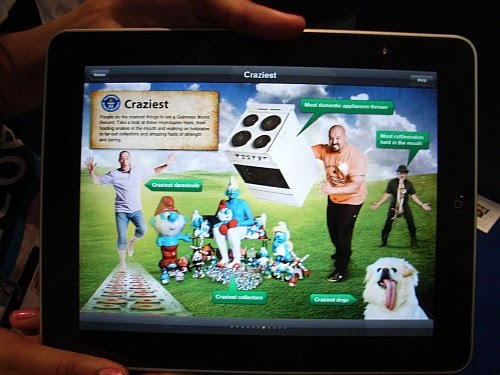
When you drill down to the content, there's a mixture of text, video, photos and audio (depending on the record you're viewing).
The device itself feels lightweight and comfortable, although I'm not sure how I would hold it if I really wanted to have a book-like experience with it. A laptop is hinged so the screen can be propped up at the right angle, and a paperback book feels easier to hold in one hand at the right angle. I only had a few minutes to play with it, though. And it's worth saying that the print book of the Guinness Book of Records is too big to hold comfortably for too long anyway. It's not the kind of book you'd take on the tube.
For the launch, the Guinness stand was attended by record holders including the world's tallest married couple and new record breaker Ben Lee who played Flight of the Bumblebee on the violin, showing the skill that helped him shave a second off the world record earlier this month. For many people, though, the real star of the show was the iPad. I wonder whether Guinness will be able to repeat its print sales record in this new digital format?Labels: ebooks, iPad, publishing
Permanent link for this post | Blog Home | Website Home | Email feedback

The seminar on writing for teenagers at this week's London Book Fair was so packed there were people sitting on the floor. This was despite the level of exhibition visitors apparently being lower because of the flight ban (about 10-15% of the stands were empty too).
Barry Cunningham, founder of Chickenhouse publishers which is now part of Scholastic, had some good advice for writers: he said it was important that teenage fiction was told from the teenage experience, and wasn't viewed from an adult experience. He cautioned against writing adult books in disguise ("in animal suits"). There's a difference between books for teenagers and books that have teenagers in them. "It's an important definition," he said. "If we get it wrong, we might as well say all books are for everybody."
The lines are becoming increasingly blurred at a time when Cunningham says booksellers have moved teenage books from the children's section into the adult section, and we've seen so many crossover books which are read by both teenagers and adults (starting with Harry Potter, but also including the Golden Compass among others).
Sophia Bennett, author of the Chickenhouse novel Threads, said that she wrote her book for herself as an 11 year old, but had her own daughters (aged 11 and 13) in mind too. She believes her title is more for 14 year olds, but gets most fan mail from 10-12 year olds who are reading ahead of their age group. She said she has been inspired as much by movies and the internet as literature, and writes short, snappy chapters for "people with attention spans as short as mine".
There was some discussion about the degree to which the authors self-censor their work. Rachel Ward, author of Numbers which was shortlisted for the Waterstones prize in 2009, said that she didn't censor and her book includes bad language, sex, and drugs. The first draft had over 100 F--- words, but during the editing process she took advice on what would be acceptable to teachers, parents and librarians. The swearing was taken down to about 20 occurences, but she says reviewers still say it's in every paragraph. "In real life, the characters would use bad language," she said. Although she described the book as a "neutered version", she also said she was "very comfortable with anything that will get [her] published". For the sequel, she was more self-conscious about who would read the book, and after receiving emails from readers realised that many of them were 12 and not 14. The bad language is still there, but not as strong.
Bennett said that she created a problem for herself in the way her series was structured. In each book, the characters age by two years but the readers are not growing up so quickly. She tried using words like "Drat!" but it seemed too artificial. She found that it took two paragraphs to replace expressions like that without using swearwords, but she said that afterwards she couldn't tell where the edit was, and it felt like she was cheating when she was relying on bursts of dialogue. She also said that booksellers she's spoken to were particularly concerned about sex in teenage books because they want to be able to recommend them to younger girls.
One key idea to emerge in the session was the importance of following your own muse. Bennett warned that if you think about it too much and try to study the market, you'll be two years behind everyone else because that's where the market is today. "Write from the heart," she said.Labels: publishing, writing
Permanent link for this post | Blog Home | Website Home | Email feedback
15 April 2010
Ebooks represent an opportunity for publishers to sell direct to customers, and to bypass the traditional sales channels. There are many reasons they might want to do this: it enables them to build a direct relationship with readers so they can better understand their needs, and it enables the publisher to make a bigger margin on the sale. It creates a massive challenge, though, which is often underestimated: customer service.
I've mentioned the Retro Gamer app a few times on this blog recently. It's an iPhone/iPod app that enables you to read issues of the magazine, which covers computer games from the 80s (or 'retro games'). I used to write games for the Amstrad CPC, so I like to dip into this magazine and the app version is cheaper and more portable than the print mag. The app features a catalogue of all the available issues, and you can use an in-app payment to buy one you want, which then downloads.
When I bought the latest issue, it failed to download correctly. Towards the back of the mag, there are about 10-15 pages that say 'downloading' on them, but which never download. There's no option to reset the download in the app, so the only solution is to file a support enquiry.
This is where the process breaks down: the print magazine has outsourced the whole operation to PixelMags, the company that makes the app. PixelMags says it responds to enquiries by the end of the next business day. But it doesn't: I've sent two enquiries (last Friday and Monday) and had no response to either of them.
As publishers move from print to digital, they need to reorientate their business around customers. Print books rarely have support issues. It's possible a book might be misprinted or wrongly bound, but I can't remember ever returning a book. In that event, the retailer, which has extensive customer service experience, would manage the replacement. In the print world, publishers can basically be creative manufacturers, shipping out crates of books and not worrying too much about end customer service. (They do have retailers as customers, but their needs are very different to readers').
Standardised formats and ebook channels (such as Apple's iBook store and the Kindle store) will help publishers revert to retail-led customer service. But when publishers want to be more innovative and sell iPhone apps or PDFs from their website, they have to make sure they can cope when things go wrong. The content delivery can be automated, but the customer satisfaction cannot. The promise of ebooks is immediate delivery, so customers expect prompt and helpful service.
Because this is an emerging technology, the publisher has more at stake than the reader does. In my case, I'm writing off a £3 purchase of an app, but the publisher is losing annual sales from me of about £30, because I'm unlikely to purchase again.
(Download a free chapter from The Customer Service Pocketbook).
UPDATE: I filed a support request with Apple, and Apple has promptly issued a refund and said it will investigate the issue. So in this case, the retailer was still able to offer an excellent service as support provider of last resort, even though it couldn't fix the downloading issue. As a result, I can continue to have faith in buying apps, although I probably won't buy any more issues from the magazine app.Labels: apps, customer service, ebooks, iPhone, iPod, publishing
Permanent link for this post | Blog Home | Website Home | Email feedback
09 April 2010
There's an interesting discussion taking place on the forum for Retro Gamer magazine at the moment. As I said in my recent post about how ebooks are changing writing, Retro Gamer has created an iPhone/iPod app for buying and reading the magazine.
Retro Gamer has many fans who are committed, or perhaps should be (as the old joke goes). They collect every issue of the mag, and now there's an iPhone app, those with iPhones will collect that too. What's interesting, though, is that several people are saying that subscribers to the print mag should get the digital version for free or for a reduction.
Editor Darran Jones said: "Why should you be given it for free? After all you don't see people saying. I've already got Die Hard on DVD, why should I have to buy the Blu-Ray version? I'm sure that some sort of deal will eventually come along that will give subscribers a better discount over those who are buying it fresh, but it doesn't normally make good business sense to give away something for nothing. After all, you're not being forced to buy it, it's just there as an option."
Reader Opa-Opa (not his/her real name) said: "The thing with your DVD/Bluray argument is that you would be paying for the media and packaging, which will cost the production company a certain amount of money to get produced and shipped etc but with the digital version of any magazine (not just RG, I'm not having a pop at you guys) the magazine is already made, it's already put together and it costs next to nothing to make all the time the paper version is being made. Do you get paid twice because you are now making two different magazines, one paper and one digital.. Because we have to pay twice if we want a digital copy..?"
There seems to be a perception that there are no costs in creating ebooks, which is not true. Even when the print version has been created, it takes time to generate the digital version, upload it to the app system and to test it. There are often significant setup costs too. I contacted PixelMags (who created the Retro Gamer app) to ask about their pricing a month ago for an article I was writing but I haven't heard back. Typical prices for creating a corporate app might be £20,000, although it's possible to do it much more cheaply and to do it on a revenue share basis. If it did cost £20,000, then it would take over 9,500 sales at £3 per copy to break even on that cost. (Apple takes 30%, and Imagine Publishing can probably amortise some of this cost across all its titles).
What about the other costs? Well, let's estimate that it takes about a day of somebody's time to look after each issue (including generating, uploading, and customer service) and that the cost of that (including office rental, furniture, employer taxes etc) is about £500. In that case, Retro Gamer needs to sell over 235 copies to break even on the cost of any one issue.
It's easy to question the figures. We could say that the cost of the staff time is half that, or equally argue that it takes twice as long. But it does demonstrate that however you slice it, digital content isn't free.
I have no idea how many copies they are selling. But Retro Gamer is a highly specialist magazine which had a print circulation of 5,000-7,000 last time I heard a rumour about it a couple of years ago. There are lots of people with iPhones and iPods, but how many of them are in the target market? It's clear that Retro Gamer has taken something of a gamble here, and won't make any profit until a significant proportion of its potential buyers have bought an issue. Only then does it start to make the profit which rewards its risk.
(It is possible it's doing it all on a revenue share basis and that PixelMags is absorbing the setup costs. But in that event, the costs are still in the system, and it's still not viable to give the content away for free).Labels: ebooks, publishing
Permanent link for this post | Blog Home | Website Home | Email feedback
20 March 2010
Within five years, Wiley's higher education division might be publishing exclusively in digital formats, according to its sales and marketing manager Neil Broomfield. Wiley is the publisher of my book Social Networking for the Older and Wiser, so this is particularly interesting to me. The Older and Wiser series is a good example of a market that will continue to demand print for some time to come, but it's possible we'll see books for many other audiences go exclusively digital.
Since I got an iPod Touch a couple of months ago, I've had a great experience with ebooks on it. I've been using GoodReader to read PDFs. There's a huge amount of content available (legally) in PDF format, including books from Sitepoint, The Pragmatic Bookshelf, and O'Reilly. I've been using GoodReader to read and it's been a mostly great experience, although sometimes it can feel a bit like reading a publication through a letterbox.
There are also some apps dedicated to particular books. I'm enjoying Seth Godin's reboot of Unleashing the Idea Virus, which includes video snippets to help bring it to life. Roger van Oech's Creative Whack Pack is a really nice application too, and there are some great illustrated books including Foxfire (a manga-style cartoon strip) and some apps based on Wallace and Gromit and Shaun the Sheep. Each one of these takes a moment to learn because you turn the page in different ways, so that might be one area where the iPad's support for ebooks can add particular value.
Not all content works perfectly on the iPod. The Retro Gamer app is great, but feels a bit like reading by microfiche. Magazine pages aren't laid out to be read top to bottom, so you end up scrolling all over the place to find the next chunk of content. It costs a fraction of the price of the printed mag, though, so the value proposition is still strong.
I'm also finding that I enjoy the convenience of having multiple publications with me at once, and having them in such a compact form. I've always dipped into and out of books. Most of the time I've got several books on the go, but that's so much easier to do when using a digital reader.
The implications for writers are interesting. Users are coming to expect a little extra in app-based books, so writers need to think about how they can add rich media and interactive features. It's relatively easy to create bolt-on bonuses, but making it integral to the proposition is much harder. The tiny screen size and the way that people dip in and out will also favour books with lots of subtitles and short sections.
One concern with ebooks is pricing. I have seen reference ebooks priced the same as hardbacks, but I'm not sure they're selling in any quantity. The price point tends to be below £3 in the UK, although some titles can push it to £5. It's extremely common to see apps priced at 59p (of which the publisher/author keeps 41p).
The low price point is offset somewhat by the ease with which apps can be distributed. I'll be writing more about this in a while, but it's not too hard for authors to self-publish an iPhone app and tap into all the iPhone and iPod Touch owners out there. Actually driving downloads (even free ones), is much harder, of course, but the challenge of self-publishing has always been in the promotion.
For some time, I've advised that journalists should learn basic HTML. We're still at the stage where learning to build apps is quite technical, but tools are starting to emerge which will help automate much of this. The next generation of writers might need to be more experienced in creating interactive content if they are to connect with readers. Even if they do not need to program, they'll need to be coming up with compelling ideas for apps that readers want.Labels: books, ebooks, iPhone, iPod, publishing, writing
Permanent link for this post | Blog Home | Website Home | Email feedback
05 February 2010
A new freesheet has launched called The London Weekly. On Twitter, it's getting a serious kicking at the moment. People are criticising its amateurish layout, and its inability to spell the name of Phil Tufnell in a front-page headline.
From the photos I've seen, it looks very much like a student newspaper. The design is boxy, it uses centred and multicoloured headlines, and leaves a lot of distracting dead space. I haven't seen a clear enough photo (or a real copy) to read the body text.
But, here are two observations:- Firstly, if you're going to criticise a publication for having typos in it, be very sure your critique does not include typos itself. I've read two blog posts on the subject of The London Weekly, and they both include errors at least as bad as those they are damning The London Weekly for.
- Secondly, shouldn't we celebrate the daring of this venture? A relatively inexperienced team has gone into a mature market with a new publication. At the end of the day, they were able to say that they actually launched a new newspaper. Okay, so maybe they'll look back on it in future and wish they had the experience or funding to do a better job of it. But, what did you launch today?
Labels: business, design, proofreading, publishing, writing
Permanent link for this post | Blog Home | Website Home | Email feedback
17 December 2009
The Evening Standard carried out an auction of unique experiences in aid of a children's charity, with the winning bids reported in yesterday's paper. What surprised me is how much people are willing to bid to have a taste of work as a writer, photographer or other media professional. Below are the media-related bids (in bold), together with a selection of other bids to give you an idea of how they compare.
- £14,600 - Dinner for 12 cooked by Gordon Ramsay (highest bid for any lot)
- £14,000 - A day with Richard Branson
- £8,100 - Two tickets for the 2010 final of Strictly Come Dancing
- £7,153 - A week on the Evening Standard's "fast-paced, hectic" newsdesk
- £5,600 - Tea with Elton John
- £5,450 - A two-week internship at Island Records, mentored by Duncan Beese who signed Amy Winehouse
- £5,300 - Dinner with the Evening Standard's editor at his favourite Notting Hill restaurant
- £3,958 - A two-hour art class with Tracey Emin
- £3,600 - Dance lesson with Anton du Beke
- £3,115 - Afternoon tea with TV and radio presenter Claudia Winkleman
- £3,100 - Artworks by Gilbert and George
- £2,801 - Take part in a Vogue fashion photo shoot (not clear whether this is as a model or helping to shoot it)
- £2,550 - A week's work experience on ES magazine
- £2,550 - Mentoring with James Caan from Dragon's Den
- £2,070 - Join BBC Five Live in the media centre at Lord's for the Test against Bangladesh
- £1,982 - Caroline Michel, boss of literary agency PFD, will critique your manuscript and give you guidance on publishing
- £1,470 - Two guests have "unprecedented access" to the Match of the Day studio
- £1,200 - A springtime stroll around the park with Bob Geldof
- £1,100 - Four people chauffeured to work by Rowan Atkinson in a Rolls Royce
Is it becoming that difficult to break into media that people are willing to pay £1,430 per day to work on the Evening Standard's news desk? Is it so hard to get the attention of an agent that somebody would rather pay £1,982 than go the long way around? Will work experience in the media deliver a better return on investment than artworks by Gilbert & George?
Of course, people don't really think like that. If they want something, they bid what they can afford to try to win it. They don't compare the lots. But I'm surprised that mentoring from James Caan (which I can see really helping a lot of businesses to reinvent themselves) is considered less valuable than a week's work experience on the ES Magazine. I'm surprised that dinner with a newspaper editor is more highly prized than time with Bob Geldof, Sebastian Coe, Jonathan Ross, Sophie Dahl, the Duchess of York, Stephen Fry and the QI team, footballer Harry Redknapp, director Guy Ritchie, Graham Norton and artist Anish Kapoor (who all featured in lower ranking bids).
Labels: business, journalism, publishing, writing
Permanent link for this post | Blog Home | Website Home | Email feedback
16 October 2009
Phew! I've finished drafting 'Social Networking for the Older and Wiser' now. It's been a great few months, digging deep into social networks. Some of them are networks that I wouldn't naturally have come across before (such as Saga Zone), and others are networks that I'm a big fan of (including Facebook, Twitter and 43Things).
At times it was confusing dealing with multiple logins, having multiple versions of myself out there in cyberspace, making friends with each other (myself?) and chatting away. But apart from that, it was great fun and wonderful to take on another book-length project and to complete it in a few months. (My previous book was a novel that took two years).
The shape of the book changed during drafting. The original plan was to dedicate a chapter each to 13 social networks, but it became clear during drafting that it would be a more useful book if it focused its attention on leading networks. The book covers 9 different social networking sites in detail now, with an appendix dedicated to introducing the other networks out there.
From now, the book goes through a technical editor, comes back to me to make any final edits, and then goes off for design. I should see the page proofs in December, it should be printed early 2010, and in the shops in February.
I've set up a dedicated page for the book now and will add to this over time, building up a minisite with more information on the book. The plan is to include the table of contents, excerpts, all the links on one page (so you don't have to type them in), reviews, and other goodies. If there's anything you find particularly useful or interesting on book websites, let me know and I'll see if I can add it for you.
The book can be preordered from Amazon now. Amazon guarantees that you will pay the lowest price between when you order and when the book is published.Labels: books, publishing, social networking, writing
Permanent link for this post | Blog Home | Website Home | Email feedback
30 September 2009
Generally speaking, I recommend publishing free chapters of books online. Readers can thumb through the real book in a shop to get a flavour of what it's like, but to stimulate sales online, a free sample is essential.
However, this only applies if the book is good. If, say, you're a former Eastenders actress who has got a book deal purely on your name; and every paragraph you write makes readers wince; and your publisher thought it would be funnier to deny you the services of a decent copyeditor; then the following advice applies: on no account publish the first chapter online.
I cannot describe how awful Martine McCutcheon's first chapter is in a way that will make you appreciate the horror. It's repetitive, has weak characterisation, banal dialogue, awful description, terrible brand placement, lots of irrelevant chit-chat and filler. Nothing happens. It's like a case study in how not to write a story.
This is the first of three novels she is threatening to unleash. I'm certain she's not working with a ghost-writer (she could afford a good one, if she were). I've got nothing against her personally and it's great that she's exploring her creativity and learning to write novels. Everyone has their story to tell, and is entitled to their creativity.
But, Pan MacMillan, really? Shouldn't you have passed this one by? Waited until she had more finely tuned her craft before unleashing it on the nation? Offered her coaching maybe so that she met the basic standards for publication before going ahead with it? Given her an editor, perhaps? Celebrities get signed because they're guaranteed to shift units, but this book is so bad I can't even see it doing that.Labels: books, publishing, writing
Permanent link for this post | Blog Home | Website Home | Email feedback
14 July 2009
 I recently attended a talk by Michelle Harrison, author of The Thirteen Treasures
 , which won the Waterstone's Children's Book Prize 2009. Michelle was wearing a red top, because wearing something red is one of the ways you can protect yourself against fairies.
In The Thirteen Treasures, a 13-year-old girl can see fairies, but they're nasty and punish her for talking (or even writing) about them. The girl (Tanya) gets the blame for the mess the fairies make, and is always in trouble with her mum. When Tanya is sent to her grandmother's house to give her mother a break from all the chaos and destruction, she comes across a girl in the woods. That girl, it transpires, was the same one who disappeared 50 years ago. How is that possible? The book unravels the mystery, and the part that the fairies play in it.
It was inspiring to hear about Michelle's journey to publication. We occasionally see stories in the press about authors who get a lucky break, but don't so often hear about those who persevere through countless rejections.
This is what Michelle's journey to publication looked like:- Spent a year drafting
- Sent draft to publisher
- Three months later, received a rejection
- Sent book to six agents
- Five said no
- One said they liked it, but didn't want to represent it yet
- Michelle edited the book using their feedback, and sent it back
- They sent a longer reply, outlining bits they still didn't like
- Michelle edited it, and sent new versions back to the agent three or four times, incorporating new feedback, over a period of 18 months
- The agent turned it down
- Michelle took another look at the book herself, decided she didn't like one of the characters and rewrote to make the character stronger
- She spent "the longest time" on a cover letter to go with this submission, and then approached the top agent on her list, a name she had been too intimidated to approach before
- They asked to meet up and then quickly signed up to represent the book. It had taken four years to get to that point.
- The agent shopped the book around publishers
- A number of publishers rejected the book, with some requesting that the book be edited for a younger audience
- Simon and Schuster signed the book
Following the book contract, Michelle worked with the publisher on edits. In her talk, she stressed the importance of trusting the publisher, whose team will be highly experienced in creating books that sell. The reason there's no fairy on the cover of the book is that the publisher said it would put boys off from reading it.
During Michelle's journey to publication, there were many points at which she could have given up. Winning the Waterstone's prize is as much a testament to her perseverance as her imagination and talent for writing.Labels: book review, books, publishing, writing
Permanent link for this post | Blog Home | Website Home | Email feedback
18 June 2009
 Business autobiographies are usually written by household name entrepreneurs, and marketed with the promise that you too can achieve riches beyond your wildest dreams. Most of the investors from Dragon's Den have spent some time on the bestseller lists and Richard Branson has three books to his name.
These books are often inspiring, revealing how far you can go with the right mix of entrepreneurial flair, hard work, creativity and a little luck. But they're also written by people who started their businesses decades ago, and so tend to be light on the early history. The mental gulf between a millionaire and a reader who hasn't yet made the first sale is hard to cross.
With her book Brand New Day, Lara Solomon builds a bridge. The book is her diary from 2004 to 2007, and shows how she set up a new business from scratch. By the end of the book, the company has six staff and has turned over AU$250k (£120k) in three months. The book is inspiring, in part because the steps Lara takes are small steps anybody could take, if they were comfortable with the risk and had equal drive.
The product is a mobile phone sock, available in a wide range of designs, with a different one reproduced in the corner of each page (nice touch). To be honest, it's not a product I could believe in and not one I could see myself buying. But one thing that's made Lara's business a success is that she's persevered even when others didn't share her enthusiasm, and she's created a market in the process.
Key themes throughout the book are the challenges Lara has recruiting and retaining good staff, the emphasis placed on building the Mocks brand, and the extent to which Lara has to work outside her comfort zone to get things done. The book reads like an honest account of those first entrepreneurial steps, and provides a rare insight into what goes on in a smaller business. Laroo, the company behind the Mocks, is based in Australia so there are a few cultural references I didn't get, but most of the lessons are applicable internationally.
Lara's self published the book, so if you'd like to read a sample or order a copy, head over to the Brand New Day website (link no longer available).
For more small business advice, check out my book Small Business Websites That Work.Labels: book review, books, business, customer service, publishing
Permanent link for this post | Blog Home | Website Home | Email feedback
02 June 2009
As ebooks become a larger part of the book industry, publishers and authors could face the same challenges from piracy that record labels and musicians have over the last ten years.
A piece in the Bookseller last week said that the Publishers' Association had identified 800 illegally uploaded works and removed 90% of them using a new anti-piracy tool.
What caught my eye about the story was the suggestion that publishers might adopt similar spoofing tactics to those used by the music industry, where fake copies of a work are uploaded by the copyright owner to confuse the pirates.
The commitment that people make to a song is minimal compared to the commitment made to a book. If you're playing a song and it turns out to be a lecture about how you should be buying it instead, you could just click 'stop'. How annoying would it be if you were 200 pages in to a pirated copy of some romantic fiction novel, when a bunch of pirates swing in on ropes yelping like Tarzan and just start killing everyone? (er... in the book, obviously). I can see a lot of creative opportunities for authors who work with publishers to create spoofed versions of their works...Labels: books, publishing
Permanent link for this post | Blog Home | Website Home | Email feedback
30 April 2009
 Last week was the London Book Fair, attended by publishers, authors and Flanimals (pictured, right).
It was interesting to see how digital books were received at the fair. There was an area at the back of the hall given over to ebooks and digital publishing, and the seminars there were packed out. But it seemed to be led by the technology, rather than the content. There were plenty of firms who could help you to repurpose and distribute your content for mobile platforms (including the iPhone and Sony Reader), but I didn't notice anybody promoting digital content.
I didn't see any discussion about how ebooks can be different to print books. A certain amount of this is built into the device (eg searchability), but there is lots of potential to create new types of content based on the written word. Mindsportlive (link no longer live) is developing iPhone apps based on its card packs, including '52 Ways to Beat Stress', but it was very much the exception.
It's partly the nature of shows like this that means major publishers would sideline their digital offerings. If you're negotiating rights, a printed book looks more impressive. Experienced publishers can get a measure of the content quickly. With ebooks, you can't tell how big they are, how well proofread they are in the middle, whether the book's consistently structured and so on without flicking through a lot of virtual pages. There's not a 'flick through until something catches my eye' button on any of the devices I've seen. Also, since the ebooks are often sold directly, they probably don't belong at a show that's partly about negotiating print book distribution and sales with intermediaries.
One company from Russia has an interesting proposition for interactive physical products - it markets hardback comic books for adults, with an enclosed music CD and CD-Rom. On the CD-Rom is a Flash animation that brings the comic book to life, and the CD contains atmospheric music that goes with the story. The project has been led by the music, with the creator being a musician first and commissioning illustration to expand on his work, which is an interesting way to create value at a time when it's increasingly difficult to sell music. For more information, check out the Ylotana website (link no longer live).
The Espresso Book Machine for printing on demand attracted a lot of attention. The Blackwell bookshop in Charing Cross Road will now be able to print books on demand using the machine, which was demonstrated at the fair. The device is a great way to increase effective footage in an expensive store, and it means many books need never go out of print. But it also transforms the bookseller into a book distributor. Surely the point of a bookshop is that you can browse and discover new titles you wouldn't have otherwise read? Isn't the idea that the bookshop can sell you books you didn't already know about? Print on demand is likely to require the shopper to ask for a specific book to be printed, although it is theoretically possible for displays to be mounted to showcase print-on-demand books, enabling infinite sales based on one shelf copy.
Other news from the show: Simon Pegg's writing a book for publication in October (hurrah!). It's an autobiography/memoir (err... okay). Enid Blyton is coming back from the dead with six new stories being ghostwritten in her (presumably trademarked) name. She wrote over 700 stories when she was alive, so you wouldn't think there would be a need for this. I wonder whether we'll see the day when John LennonTM releases a new album? Perhaps we have more respect for the personal creativity of songwriters than we do of book authors. Or perhaps it just needs another fifty years before The Beatles, Pink Floyd, Led Zepellin and Abba become brand names attached to ghostwritten work.
While at the show, I got some useful feedback on my novel University of Death from successful self-publishers, including Pauline Rowson, who writes and publishes crime fiction and business books. She has given me some great ideas for how I can make the book (or my next book) more marketable. Shows like this are always a good opportunity to pick up new ideas - I came back home with more ideas than I know what to do with.Labels: book review, books, marketing, publishing, university of death, writing
Permanent link for this post | Blog Home | Website Home | Email feedback
30 August 2008
 The new issue of Metal Hammer magazine (dated September 2008) includes a review of my novel 'University of Death' on p91. The review says the book is:
"A fun novel about the problems faced by musicians in making their mark on a music industry that's falling apart. A bitter satire that works its way up to a memorable finale."
The full review makes reference to my non-fiction book 'Small Business Websites That Work' and says I'm letting my hair down here and having some fun. It's a comical observation in some ways, although there's no reason why someone shouldn't be an expert on website building and a passionate music fan. My press backgrounder for UoD mentions my non-fiction books as a way to establish my credibility as a published author. It's one way to differentiate myself from the many self-publishers out there, some of whom (whisper it now) aren't very readable.
For independent publishers, reviews are a valuable way of demonstrating credibility and publicising books, and I'm delighted to receive such a positive endorsement from Metal Hammer magazine. I'll be updating the book cover with this review quote. Although the book isn't available in the shops, each copy that's lying around in somebody's house or workplace is also an advert and good cover copy can help others to take an interest in the book and start reading.
The editor kindly published my website address with the review, although the exact URL published was unfortunately wrong. I've fixed it on the server so it redirects, but I'm also going to count the number of visits originating from that review, which will be an interesting experiment. It's difficult to attribute any sales or website traffic to particular coverage, but I do have an opportunity here to tie up the review with the resulting website visits (even if I can't follow that through to sales at the moment).
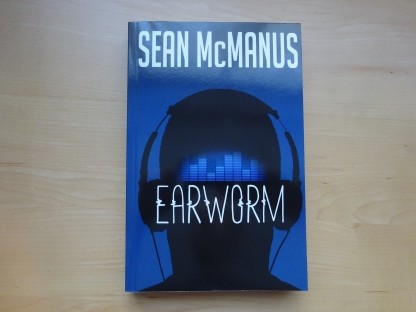
UPDATE: University of Death has been updated and republished under the title Earworm.
Labels: book review, books, publishing, university of death
Permanent link for this post | Blog Home | Website Home | Email feedback
14 August 2008
You might already have heard of Garfield Minus Garfield, a cartoon strip created by Dan Walsh by editing Garfield out of the original cartoon strips. You're left with Jon, a lonely man who appears to be slowly cracking up. The empty frames create a sense of time crawling along.
Creative projects like that are risky - it's not uncommon for the original artists and writers to stamp out unauthorised derivative works. Jim Davis, though, has been supportive. He told The Washington Post (and much kudos to Walsh for getting his site covered there) that the site was "an inspired thing to do" and he wanted to thank Walsh for "enabling him to see another side of Garfield".
Now, there's going to be a book that puts the original Garfield strips alongside Walsh's edited strips. This seems like a great way for Davis to celebrate Garfield's 30th birthday, and it's a nice model for how cartoon strip writers can involve readers and package user generated content commercially.
I'm curious about how Walsh's creative input is being recognised - I doubt he's getting a half share as co-author, but I hope that his creativity is being compensated fairly. Particularly since a lot of people who have never bought a Garfield book might be inspired to do so because of the 'Minus Garfield' juxtaposition.
Scott Adams has mashups on his Dilbert site (link no longer available), which enable readers to replace his final frame with their own punchlines. Visitors can vote on which jokes they like best. This could make for a great book too, although the main value is the way that it involves the readers with the work and inspires them to visit Adams' site every day.
I have heard a conspiracy theory that the Fred Bassett cartoons are all missing a final frame which contains the punchline, which is why they're mostly unfunny. Perhaps that could be the next candidate for a writer-reader mashup?Labels: books, business, comedy, publishing, writing
Permanent link for this post | Blog Home | Website Home | Email feedback



 Top | Search | Help | Privacy | Access Keys | Contact me